Seychelles weather by month
Average temperatures and rainfall across Seychelles, based on 30 years of climate data.
The average temperature in Seychelles is around 26° across the year, though it swings month to month and from region to region. The figures below show the monthly pattern for Victoria.
- Hottest
- Apr
- 28°
- Coldest
- Jul
- 25°
- Wettest
- Jan
- 226 mm
- Driest
- Jul
- 52 mm
- Annual avg
- 26°
- year-round
- Rain / yr
- 1485 mm
- 191 wet days
- Largest city
- Victoria
- 23k people
- Cities
- 3
- with climate data
Monthly climate (Victoria)
Average highs, lows and rainfall through the year for Victoria, Seychelles's largest city.
| Month | High / Low | Rainfall | Wet days |
|---|---|---|---|
| Jan | 27° / 26° | 226 mm | 20.9 |
| Feb | 28° / 26° | 120 mm | 12.7 |
| Mar | 28° / 27° | 108 mm | 15.1 |
| Apr | 28° / 27° | 107 mm | 16.8 |
| May | 28° / 27° | 139 mm | 17.3 |
| Jun | 27° / 26° | 83 mm | 13.6 |
| Jul | 26° / 25° | 52 mm | 11 |
| Aug | 26° / 25° | 63 mm | 12.6 |
| Sep | 26° / 25° | 119 mm | 15.7 |
| Oct | 27° / 26° | 121 mm | 15.6 |
| Nov | 27° / 26° | 144 mm | 17 |
| Dec | 27° / 26° | 203 mm | 22.8 |
Weather across Seychelles
| City | Through the year | Avg | Warmest | Best month |
|---|---|---|---|---|
| Victoria La Riviere Anglaise | 26° | 28° (Apr) | Jul | |
| Beau Vallon | 26° | 28° (Apr) | Jul | |
| Takamaka | 26° | 28° (Apr) | Jul |
Climate in Victoria
Full Victoria forecastVictoria is the largest city in Seychelles; its cloud cover, humidity, wind and sunshine are typical of the surrounding region.
Clouds and sunshine
How often the daytime sky is clear, partly cloudy or overcast through the year.
In Victoria, the average share of the sky covered by clouds shows significant seasonal variation over the course of the year.
The clearer part of the year begins around March 8 and lasts for 2.6 months, ending around May 25. The clearest month is April, when the sky is clear, mostly clear, or partly cloudy 64% of the time on average.
The cloudier part of the year begins around May 26 and lasts for 3.7 months, ending around September 16. The cloudiest month is July, when it is overcast or mostly cloudy 66% of the time.
Humidity comfort
Share of days at each humidity comfort level, based on the dew point — the measure that tracks how muggy it actually feels.
Wind
Average wind speed through the year, banded into plain-language speed zones so a number reads as 'breezy' or 'calm' without knowing the scale.
This is the average sustained wind speed at the standard 10 metres above open ground — the steady flow a weather station reports, not the sharper gusts that come and go, which can run half again as fast. It's the number that says whether a place is generally breezy or calm.
Across the year, average wind speed in Victoria is typically light breeze, near 19 km/h, and varies a lot with the seasons.
The windier part of the year lasts 4.9 months, from around May 18 to Oct 12. The windiest month is August, averaging about 27 km/h (breezy).
The calmer part of the year runs from around Oct 13 to May 17, with April the calmest month at about 12 km/h.
| Jan | Feb | Mar | Apr | May | Jun | Jul | Aug | Sep | Oct | Nov | Dec | |
|---|---|---|---|---|---|---|---|---|---|---|---|---|
| Wind speed (km/h) | 16 | 16 | 13 | 12 | 19 | 25 | 26 | 27 | 25 | 18 | 14 | 15 |
| Feels | light breeze | light breeze | light breeze | light breeze | light breeze | breezy | breezy | breezy | breezy | light breeze | light breeze | light breeze |
| Wind speed (km/h) | Feels | |
|---|---|---|
| Jan | 16 | light breeze |
| Feb | 16 | light breeze |
| Mar | 13 | light breeze |
| Apr | 12 | light breeze |
| May | 19 | light breeze |
| Jun | 25 | breezy |
| Jul | 26 | breezy |
| Aug | 27 | breezy |
| Sep | 25 | breezy |
| Oct | 18 | light breeze |
| Nov | 14 | light breeze |
| Dec | 15 | light breeze |
Best time to visit Seychelles
A 0–10 score combining daytime comfort, chance of rain and cloud cover — the sweet spot runs mid May to early December.
Solar energy
Average daily shortwave solar energy reaching the ground, banded into brightness zones so the number means something at a glance.
Solar energy is how much sunlight actually reaches the ground each day, measured in kilowatt-hours per square metre (kWh/m²) — the combined effect of how long the sun is up, how high it climbs, and how much cloud gets in the way. It's the raw fuel a solar panel has to work with: for scale, 1 kWh/m² a day is dim and wintry, while 7+ is desert-bright.
Victoria receives about 5.8 kWh/m² a day of solar energy — bright — and it stays remarkably steady, holding between 5.1 and 6.3 kWh/m² all year. For solar panels, output here is a flat line, not a seasonal wave.
Where is Seychelles?
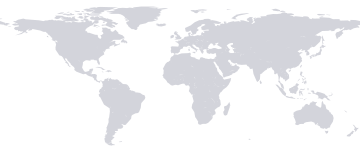
Seychelles sits around 4.6°S, 55.5°E. The marker shows Victoria, its largest city, among 3 cities with climate data here.
Seychelles travel facts
- Travel advisory
- Level 1
- Exercise Normal Precautions
- Power plugs
- Type G
- 240 V · 50 Hz
- Prices
- ≈ 54% of US
- price level, 2025
- GDP per capita
- $19,449
- 2025
- Safe drinking water
- 65%
- of population, 2024
- Homicide rate
- 8
- per 100k, 2022
- Road deaths
- 11.3
- per 100k/yr, 2019
- Income group
- High
- World Bank
- Religion
Sources: World Bank, US State Department, World Happiness Report, WHO/UNICEF, EF EPI, CIA World Factbook.