Climate and average weather in Gävle
In Gävle, the summers are mild, showery, and partly cloudy and the winters are very cold, snowy, and mostly cloudy.
Over the course of the year, the temperature in Gävle typically varies from -6°C to 22°C, and is rarely below -14°C or above 28°C. July is the hottest month of the year, while January is the coldest.
Based on the travel score, the best time of year to visit Gävle for warm-weather activities is from late May to mid September.
- Hottest
- Jul
- 22°
- Coldest
- Jan
- -5°
- Wettest
- Aug
- 72 mm
- Driest
- Feb
- 28 mm
- Rain / yr
- 555 mm
- 112 wet days
- Daylight
- 5.3–18.7 h
- shortest–longest
- Elevation
- 3 m
- 60.7°N
- Clearest
- May
- 63% cloud
Gävle is urban area in Gävle Municipality, Sweden.
- Air quality
- Good
- PM10 16.2 µg/m³ · 2019
- Founded
- 1446
Air quality: WHO Ambient Air Quality Database. Density & description: Wikidata (CC0), GeoNames.
Gävle weather by month, at a glance
The whole year in one picture — sky, rain, humidity, temperature and travel score. Click any band to jump to its full chart.
Each stripe is one measure across the whole year, stacked so a single day reads top to bottom. The sky band runs overcast grey on top down to clear blue at the base — more blue means sunnier — followed by the rainfall curve, the humidity band, a temperature strip that tints each stretch of the year by how warm its average high is, and the travel-score line at the foot. Scan straight down any date to read that day across every measure at once; the score climbs highest around late May to mid September.
Temperature through the year
Daily average highs and lows in Gävle, from 1991–2020 of climate data. The shaded bands show the range most days fall in — 10th to 90th percentile.
The hot season lasts 3.5 months, from May 28 to September 10, with daily high temperatures above 17°C. The hottest month of the year in Gävle is July, with an average high of 22°C and low of 12°C.
The cool season lasts 4.0 months, from November 15 to March 15, with daily high temperatures below 4°C. The coldest month of the year in Gävle is January, with an average low of -5°C and high of -0°C.
Days typically run about 7°C warmer than nights, with the widest day–night swing (around 10°C) in May.
| Jan | Feb | Mar | Apr | May | Jun | Jul | Aug | Sep | Oct | Nov | Dec | |
|---|---|---|---|---|---|---|---|---|---|---|---|---|
| Avg high (°C) | 0 | 0 | 4 | 9 | 15 | 19 | 22 | 21 | 16 | 9 | 4 | 1 |
| Avg low (°C) | -5 | -6 | -3 | 0 | 5 | 9 | 12 | 11 | 8 | 3 | 0 | -4 |
| Avg high (°C) | Avg low (°C) | |
|---|---|---|
| Jan | 0 | -5 |
| Feb | 0 | -6 |
| Mar | 4 | -3 |
| Apr | 9 | 0 |
| May | 15 | 5 |
| Jun | 19 | 9 |
| Jul | 22 | 12 |
| Aug | 21 | 11 |
| Sep | 16 | 8 |
| Oct | 9 | 3 |
| Nov | 4 | 0 |
| Dec | 1 | -4 |
How hot and cold Gävle really feels
The felt-temperature range through the year — heat index on the day's high (summer humidity), wind chill on the night's low (winter wind). The dashed lines are the plain thermometer; the gap is how much hotter or colder it really feels.
On the coldest nights, wind chill pulls the feels-like down to about -12°C (around January 30), with roughly 205 freezing days a year (feels-like at or below 0°C) — 70 of them bitterly cold — worst in January.
| Jan | Feb | Mar | Apr | May | Jun | Jul | Aug | Sep | Oct | Nov | Dec | |
|---|---|---|---|---|---|---|---|---|---|---|---|---|
| Feels-like high (°C) | 0 | 0 | 4 | 9 | 15 | 19 | 22 | 21 | 16 | 9 | 4 | 1 |
| Air high (°C) | 0 | 0 | 4 | 9 | 15 | 19 | 22 | 21 | 16 | 9 | 4 | 1 |
| Feels-like low (°C) | -11 | -11 | -8 | -4 | 2 | 8 | 12 | 11 | 5 | 0 | -4 | -9 |
| Air low (°C) | -5 | -6 | -3 | 0 | 5 | 9 | 12 | 11 | 8 | 3 | 0 | -4 |
| Feels-like high (°C) | Air high (°C) | Feels-like low (°C) | Air low (°C) | |
|---|---|---|---|---|
| Jan | 0 | 0 | -11 | -5 |
| Feb | 0 | 0 | -11 | -6 |
| Mar | 4 | 4 | -8 | -3 |
| Apr | 9 | 9 | -4 | 0 |
| May | 15 | 15 | 2 | 5 |
| Jun | 19 | 19 | 8 | 9 |
| Jul | 22 | 22 | 12 | 12 |
| Aug | 21 | 21 | 11 | 11 |
| Sep | 16 | 16 | 5 | 8 |
| Oct | 9 | 9 | 0 | 3 |
| Nov | 4 | 4 | -4 | 0 |
| Dec | 1 | 1 | -9 | -4 |
Average hourly temperature in Gävle
A compact picture of the whole year, hour by hour: each column is a day, each row an hour, and the color is the modeled average temperature. Darker overlays mark night, lighter ones the civil-twilight hours around sunrise and sunset.
Read left to right for the day of the year and top to bottom for the hour of the day; the color is the modeled temperature, cool blues through to hot reds on the same scale as the other charts. A vertical slice is a single day's swing — coolest just before dawn, warmest in the mid-afternoon — while a horizontal slice follows one hour across the seasons. The darker overlay marks night and the lighter one the twilight around sunrise and sunset. Colors run warmest on July afternoons, near 22°C, and coldest before dawn in January, near -5°C.
Gävle weather by month
Every month at a glance. Click a month for its detailed page.
| Month | High / Low (°C) | Rainfall (mm) | Wet days | Snow days | Daylight (hours) | Travel score |
|---|---|---|---|---|---|---|
| Jan | -0° / -5° | 33 | 8.1 | 6.9 | 6.2 | 0.0 |
| Feb | 0° / -6° | 28 | 7.1 | 6.9 | 8.5 | 0.0 |
| Mar | 4° / -3° | 28 | 7.4 | 6.1 | 11.3 | 0.1 |
| Apr | 9° / 0° | 33 | 7.6 | 2.2 | 14.2 | 2.1 |
| May | 15° / 5° | 44 | 9.3 | 0.4 | 16.9 | 4.5 |
| Jun | 19° / 9° | 61 | 10.5 | 0 | 18.6 | 5.9 |
| Jul | 22° / 12° | 68 | 11.5 | 0 | 17.9 | 6.3 |
| Aug | 21° / 11° | 72 | 12 | 0 | 15.5 | 6.0 |
| Sep | 16° / 8° | 45 | 8.8 | 0 | 12.6 | 4.9 |
| Oct | 9° / 3° | 55 | 9.7 | 0.5 | 9.7 | 1.9 |
| Nov | 4° / -0° | 46 | 9.9 | 3.9 | 7 | 0.1 |
| Dec | 1° / -4° | 42 | 9.6 | 6.9 | 5.4 | 0.0 |
Chance of rain
How likely it is to rain on a typical day, and how that shifts across the wetter and drier seasons.
Gävle gets about 555 mm of precipitation a year. On a typical day the chance of rain is often wet, but that rises and falls sharply with the seasons.
The wetter season lasts 3.6 months, from around May 22 to Sep 8, peaking in August at about 40% chance on a given day. The drier stretch runs the rest of the year, bottoming out around Mar 22.
August is the wettest month by volume, with 72 mm over about 12 wet days; February is the driest, with 28 mm. Some of the cold-season precipitation falls as snow.
| Jan | Feb | Mar | Apr | May | Jun | Jul | Aug | Sep | Oct | Nov | Dec | |
|---|---|---|---|---|---|---|---|---|---|---|---|---|
| Rain on a day (%) | 27 | 25 | 24 | 26 | 29 | 35 | 37 | 38 | 31 | 31 | 33 | 31 |
| Rain days | 8 | 7 | 7 | 8 | 9 | 11 | 12 | 12 | 9 | 10 | 10 | 10 |
| Rain on a day (%) | Rain days | |
|---|---|---|
| Jan | 27 | 8 |
| Feb | 25 | 7 |
| Mar | 24 | 7 |
| Apr | 26 | 8 |
| May | 29 | 9 |
| Jun | 35 | 11 |
| Jul | 37 | 12 |
| Aug | 38 | 12 |
| Sep | 31 | 9 |
| Oct | 31 | 10 |
| Nov | 33 | 10 |
| Dec | 31 | 10 |
Monthly rainfall
Over a full year, Gävle collects about 555 mm of rain across 112 wet days — roughly 46 mm in an average month.
It doesn’t fall evenly. August is the wettest month with 72 mm, while February is the driest at just 28 mm. The three wettest months alone bring about 36% of the year’s total, and some of the cold-season precipitation falls as snow.
| Jan | Feb | Mar | Apr | May | Jun | Jul | Aug | Sep | Oct | Nov | Dec | |
|---|---|---|---|---|---|---|---|---|---|---|---|---|
| Rainfall (mm) | 33 | 28 | 28 | 33 | 44 | 61 | 68 | 72 | 45 | 55 | 46 | 42 |
| Rain days | 8 | 7 | 7 | 8 | 9 | 11 | 12 | 12 | 9 | 10 | 10 | 10 |
| Snow days | 7 | 7 | 6 | 2 | 0 | 0 | 0 | 0 | 0 | 1 | 4 | 7 |
| Rainfall (mm) | Rain days | Snow days | |
|---|---|---|---|
| Jan | 33 | 8 | 7 |
| Feb | 28 | 7 | 7 |
| Mar | 28 | 7 | 6 |
| Apr | 33 | 8 | 2 |
| May | 44 | 9 | 0 |
| Jun | 61 | 11 | 0 |
| Jul | 68 | 12 | 0 |
| Aug | 72 | 12 | 0 |
| Sep | 45 | 9 | 0 |
| Oct | 55 | 10 | 1 |
| Nov | 46 | 10 | 4 |
| Dec | 42 | 10 | 7 |
Snow in Gävle
Average snowy days through the year, the snow-season span, and estimated snowfall — for ski trips and the perennial 'will there be snow at Christmas?' question.
Gävle averages about 34 snowy days a year. Snow season runs roughly Oct 17 to May 13 — about 6.9 months.
December is snowiest, with roughly 7 days of snow and an estimated 26 cm of snowfall. Over the year that adds up to an estimated 124 cm of snow.
| Jan | Feb | Mar | Apr | May | Jun | Jul | Aug | Sep | Oct | Nov | Dec | |
|---|---|---|---|---|---|---|---|---|---|---|---|---|
| Snow days | 7 | 7 | 6 | 2 | 0 | 0 | 0 | 0 | 0 | 1 | 4 | 7 |
| Snowfall (cm) | 25 | 24 | 19 | 10 | 3 | 0 | 0 | 0 | 0 | 2 | 15 | 26 |
| Snow days | Snowfall (cm) | |
|---|---|---|
| Jan | 7 | 25 |
| Feb | 7 | 24 |
| Mar | 6 | 19 |
| Apr | 2 | 10 |
| May | 0 | 3 |
| Jun | 0 | 0 |
| Jul | 0 | 0 |
| Aug | 0 | 0 |
| Sep | 0 | 0 |
| Oct | 1 | 2 |
| Nov | 4 | 15 |
| Dec | 7 | 26 |
Clouds and sunshine
How often the daytime sky is clear, partly cloudy or overcast.
In Gävle, the average share of the sky covered by clouds shows moderate seasonal variation over the course of the year.
The clearer part of the year begins around June 25 and lasts for 3.1 months, ending around September 26. The clearest month is May, when the sky is clear, mostly clear, or partly cloudy 41% of the time on average.
The cloudier part of the year begins around September 27 and lasts for 5.3 months, ending around March 6. The cloudiest month is November, when it is overcast or mostly cloudy 76% of the time.
| Jan | Feb | Mar | Apr | May | Jun | Jul | Aug | Sep | Oct | Nov | Dec | |
|---|---|---|---|---|---|---|---|---|---|---|---|---|
| Clearer (%) | 28 | 31 | 39 | 41 | 41 | 37 | 41 | 37 | 37 | 32 | 24 | 28 |
| Cloudier (%) | 72 | 69 | 61 | 59 | 59 | 63 | 59 | 63 | 63 | 68 | 76 | 72 |
| Clearer (%) | Cloudier (%) | |
|---|---|---|
| Jan | 28 | 72 |
| Feb | 31 | 69 |
| Mar | 39 | 61 |
| Apr | 41 | 59 |
| May | 41 | 59 |
| Jun | 37 | 63 |
| Jul | 41 | 59 |
| Aug | 37 | 63 |
| Sep | 37 | 63 |
| Oct | 32 | 68 |
| Nov | 24 | 76 |
| Dec | 28 | 72 |
Daylight, sunrise and sunset
Hours of daylight through the year, with sunrise and sunset times.
The gold band is daylight — sunrise runs along its lower edge, sunset along the upper — so it widens toward summer and pinches toward winter, with night the dark area above and below. The longest day, around June 16, brings about 18 h 42 min of light; the shortest, around December 15, only 5 h 18 min — a swing of roughly 13 h 24 min.
| Jan | Feb | Mar | Apr | May | Jun | Jul | Aug | Sep | Oct | Nov | Dec | |
|---|---|---|---|---|---|---|---|---|---|---|---|---|
| Daylight (h) | 6.2 | 8.5 | 11.3 | 14.2 | 16.9 | 18.6 | 17.9 | 15.5 | 12.6 | 9.7 | 7.0 | 5.4 |
| Sunrise (AM) | 8:57 | 7:49 | 6:22 | 4:44 | 3:19 | 2:32 | 2:58 | 4:11 | 5:29 | 6:46 | 8:09 | 9:08 |
| Sunset (PM) | 3:05 | 4:23 | 5:40 | 7:00 | 8:16 | 9:12 | 8:56 | 7:40 | 6:02 | 4:27 | 3:05 | 2:27 |
| Daylight (h) | Sunrise (AM) | Sunset (PM) | |
|---|---|---|---|
| Jan | 6.2 | 8:57 | 3:05 |
| Feb | 8.5 | 7:49 | 4:23 |
| Mar | 11.3 | 6:22 | 5:40 |
| Apr | 14.2 | 4:44 | 7:00 |
| May | 16.9 | 3:19 | 8:16 |
| Jun | 18.6 | 2:32 | 9:12 |
| Jul | 17.9 | 2:58 | 8:56 |
| Aug | 15.5 | 4:11 | 7:40 |
| Sep | 12.6 | 5:29 | 6:02 |
| Oct | 9.7 | 6:46 | 4:27 |
| Nov | 7.0 | 8:09 | 3:05 |
| Dec | 5.4 | 9:08 | 2:27 |
Sunny days
How many genuinely sunny days each month brings — days the sky stays clear or mostly clear — banded into plain-language zones.
Gävle averages about 6 sunny days a month — counting the days the sky stays clear or mostly clear — with a clear seasonal swing between 4 and 8 days.
The sunnier stretch runs 4.2 months, from around Feb 5 to Jun 11. The sunniest month is May, with roughly 7 sunny days (gloomy).
The greyest month is November, down near 5 sunny days — about 36% fewer than the May peak.
| Jan | Feb | Mar | Apr | May | Jun | Jul | Aug | Sep | Oct | Nov | Dec | |
|---|---|---|---|---|---|---|---|---|---|---|---|---|
| Sunny days | 5 | 6 | 7 | 7 | 7 | 6 | 6 | 5 | 6 | 6 | 5 | 6 |
| Sky | Gloomy | Gloomy | Gloomy | Gloomy | Gloomy | Gloomy | Gloomy | Gloomy | Gloomy | Gloomy | Gloomy | Gloomy |
| Sunny days | Sky | |
|---|---|---|
| Jan | 5 | Gloomy |
| Feb | 6 | Gloomy |
| Mar | 7 | Gloomy |
| Apr | 7 | Gloomy |
| May | 7 | Gloomy |
| Jun | 6 | Gloomy |
| Jul | 6 | Gloomy |
| Aug | 5 | Gloomy |
| Sep | 6 | Gloomy |
| Oct | 6 | Gloomy |
| Nov | 5 | Gloomy |
| Dec | 6 | Gloomy |
Humidity comfort
Share of days at each humidity comfort level, based on the dew point — the measure that tracks how muggy it actually feels.
Humidity comfort is graded by the dew point — the temperature at which the air would be fully saturated — because it tracks how muggy it actually feels far better than relative humidity does. A low dew point feels dry and crisp; a high one feels sticky and oppressive no matter the reading on a humidity gauge.
In Gävle, the air stays dry or comfortable essentially all year. Even in August, the muggiest month, it feels humid or worse only about 7% of the time — humidity is not something you need to plan around here.
| Jan | Feb | Mar | Apr | May | Jun | Jul | Aug | Sep | Oct | Nov | Dec | |
|---|---|---|---|---|---|---|---|---|---|---|---|---|
| Dry (%) | 100 | 100 | 100 | 100 | 100 | 94 | 68 | 68 | 95 | 100 | 100 | 100 |
| Comfortable (%) | 0 | 0 | 0 | 0 | 0 | 6 | 26 | 25 | 5 | 0 | 0 | 0 |
| Humid (%) | 0 | 0 | 0 | 0 | 0 | 0 | 5 | 6 | 0 | 0 | 0 | 0 |
| Muggy (%) | 0 | 0 | 0 | 0 | 0 | 0 | 0 | 1 | 0 | 0 | 0 | 0 |
| Dry (%) | Comfortable (%) | Humid (%) | Muggy (%) | |
|---|---|---|---|---|
| Jan | 100 | 0 | 0 | 0 |
| Feb | 100 | 0 | 0 | 0 |
| Mar | 100 | 0 | 0 | 0 |
| Apr | 100 | 0 | 0 | 0 |
| May | 100 | 0 | 0 | 0 |
| Jun | 94 | 6 | 0 | 0 |
| Jul | 68 | 26 | 5 | 0 |
| Aug | 68 | 25 | 6 | 1 |
| Sep | 95 | 5 | 0 | 0 |
| Oct | 100 | 0 | 0 | 0 |
| Nov | 100 | 0 | 0 | 0 |
| Dec | 100 | 0 | 0 | 0 |
Wind
Average wind speed through the year, banded into plain-language speed zones so a number reads as 'breezy' or 'calm' without knowing the scale.
This is the average sustained wind speed at the standard 10 metres above open ground — the steady flow a weather station reports, not the sharper gusts that come and go, which can run half again as fast. It's the number that says whether a place is generally breezy or calm.
Across the year, average wind speed in Gävle is typically light breeze, near 13 km/h, and varies little with the seasons.
The windier part of the year lasts 6.3 months, from around Sep 25 to Apr 3. The windiest month is January, averaging about 15 km/h (light breeze).
The calmer part of the year runs from around Apr 4 to Sep 24, with July the calmest month at about 11 km/h.
| Jan | Feb | Mar | Apr | May | Jun | Jul | Aug | Sep | Oct | Nov | Dec | |
|---|---|---|---|---|---|---|---|---|---|---|---|---|
| Wind speed (km/h) | 15 | 14 | 13 | 12 | 12 | 11 | 11 | 11 | 13 | 13 | 14 | 15 |
| Feels | light breeze | light breeze | light breeze | light breeze | calm | calm | calm | calm | light breeze | light breeze | light breeze | light breeze |
| Wind speed (km/h) | Feels | |
|---|---|---|
| Jan | 15 | light breeze |
| Feb | 14 | light breeze |
| Mar | 13 | light breeze |
| Apr | 12 | light breeze |
| May | 12 | calm |
| Jun | 11 | calm |
| Jul | 11 | calm |
| Aug | 11 | calm |
| Sep | 13 | light breeze |
| Oct | 13 | light breeze |
| Nov | 14 | light breeze |
| Dec | 15 | light breeze |
Best time to visit Gävle
To characterize how pleasant the weather is in Gävle throughout the year, we compute two travel scores — one for general sightseeing, one for beach and pool weather.
Around early June, Gävle is still near the start of its best-weather window — great conditions with the peak-season crowds not yet at full swing.
Inferred from the travel-score curve; month-by-month visitor numbers are a planned addition.
The travel score favors clear, rainless days with daytime highs between 18°C and 28°C. Based on this score, the best time of year to visit Gävle for general outdoor tourist activities is from late May to mid September, with a peak score in the last week of July.
The travel score (filled area), and its constituents: the temperature score (red line), the cloud cover score (blue line), and the precipitation score (green line).
| Jan | Feb | Mar | Apr | May | Jun | Jul | Aug | Sep | Oct | Nov | Dec | |
|---|---|---|---|---|---|---|---|---|---|---|---|---|
| Travel score (0–10) | 0.0 | 0.0 | 0.2 | 2.1 | 4.5 | 5.9 | 6.3 | 6.0 | 4.8 | 1.9 | 0.1 | 0.0 |
| Rating | poor | poor | poor | poor | fair | good | good | good | fair | poor | poor | poor |
| Travel score (0–10) | Rating | |
|---|---|---|
| Jan | 0.0 | poor |
| Feb | 0.0 | poor |
| Mar | 0.2 | poor |
| Apr | 2.1 | poor |
| May | 4.5 | fair |
| Jun | 5.9 | good |
| Jul | 6.3 | good |
| Aug | 6.0 | good |
| Sep | 4.8 | fair |
| Oct | 1.9 | poor |
| Nov | 0.1 | poor |
| Dec | 0.0 | poor |
The beach/pool score favors clear, rainless days with daytime highs between 24°C and 34°C. Based on this score, the best time of year to visit Gävle for hot-weather activities is from early July to mid August, with a peak score in the last week of July.
The beach/pool score (filled area), and its constituents: the temperature score (red line), the cloud cover score (blue line), and the precipitation score (green line).
What to pack for Gävle, by month
Month by month, what's worth putting in the bag — from the temperature range, rain chance, sun and wind. Tap a month for a quick packing note.
For a warm-season trip around July (highs near 22°C), the essentials are rain gear and sun protection. In the cold season around January (highs near -0°C), pack a warm layer, a heavy coat and rain gear.
In July, Gävle sees daytime highs around 22°C and nights near 12°C. Worth packing: rain gear and sun protection. About 12 days see rain.
Sea temperature near Gävle
Average ocean temperature at the nearest coast, month by month, banded into swim-comfort zones — the other half of the beach question.
The sea at the nearest coast (about 14 km away) is warmest in August at about 17°C and coldest in February near 1°C.
The water stays below 20°C all year — cool enough that most swimmers want a wetsuit.
| Jan | Feb | Mar | Apr | May | Jun | Jul | Aug | Sep | Oct | Nov | Dec | |
|---|---|---|---|---|---|---|---|---|---|---|---|---|
| Sea temperature (°C) | 1 | 1 | 1 | 2 | 6 | 11 | 16 | 17 | 13 | 9 | 6 | 3 |
| Comfort | Bracing | Bracing | Bracing | Bracing | Bracing | Bracing | Cool | Cool | Bracing | Bracing | Bracing | Bracing |
| Sea temperature (°C) | Comfort | |
|---|---|---|
| Jan | 1 | Bracing |
| Feb | 1 | Bracing |
| Mar | 1 | Bracing |
| Apr | 2 | Bracing |
| May | 6 | Bracing |
| Jun | 11 | Bracing |
| Jul | 16 | Cool |
| Aug | 17 | Cool |
| Sep | 13 | Bracing |
| Oct | 9 | Bracing |
| Nov | 6 | Bracing |
| Dec | 3 | Bracing |
UV index (midday) in Gävle by month
Clear-sky midday UV index through the year, shaded by the WHO exposure levels — how much sun protection each month calls for.
Under clear skies, the midday UV index in Gävle peaks around June 17 at about 5 (moderate) — a little sun protection helps at midday. It bottoms out near December 19 at about 0 (low).
The index reaches 3 or more — the level where the WHO recommends sun protection — in 4 months of the year.
| Jan | Feb | Mar | Apr | May | Jun | Jul | Aug | Sep | Oct | Nov | Dec | |
|---|---|---|---|---|---|---|---|---|---|---|---|---|
| UV index (midday) | 0 | 1 | 2 | 2 | 4 | 5 | 4 | 4 | 3 | 1 | 0 | 0 |
| Level | Low | Low | Low | Moderate | Moderate | Moderate | Moderate | Moderate | Moderate | Low | Low | Low |
| UV index (midday) | Level | |
|---|---|---|
| Jan | 0 | Low |
| Feb | 1 | Low |
| Mar | 2 | Low |
| Apr | 2 | Moderate |
| May | 4 | Moderate |
| Jun | 5 | Moderate |
| Jul | 4 | Moderate |
| Aug | 4 | Moderate |
| Sep | 3 | Moderate |
| Oct | 1 | Low |
| Nov | 0 | Low |
| Dec | 0 | Low |
Average hourly UV index in Gävle
Modeled clear-sky UV for every hour of every day — when in the day sun protection actually matters.
The whole year hour by hour: each column is a day, each row an hour, and the color is the modeled clear-sky UV index — the midday peak scaled down as the sun sits lower in the sky. Darker overlays mark night, lighter ones the civil-twilight hours around sunrise and sunset.
UV falls off far faster than brightness as the sun drops, so even in June the burn window is concentrated in the middle of the day: about 6.5 hours a day reach index 3 (protection recommended). Mornings and late afternoons stay comparatively gentle year round.
| Jan | Feb | Mar | Apr | May | Jun | Jul | Aug | Sep | Oct | Nov | Dec | |
|---|---|---|---|---|---|---|---|---|---|---|---|---|
| UV ≥ 3 (h/day) | 0 | 0 | 0 | 0 | 5 | 6.5 | 5.5 | 4 | 0 | 0 | 0 | 0 |
| UV ≥ 6 (h/day) | 0 | 0 | 0 | 0 | 0 | 0 | 0 | 0 | 0 | 0 | 0 | 0 |
| UV ≥ 3 (h/day) | UV ≥ 6 (h/day) | |
|---|---|---|
| Jan | 0 | 0 |
| Feb | 0 | 0 |
| Mar | 0 | 0 |
| Apr | 0 | 0 |
| May | 5 | 0 |
| Jun | 6.5 | 0 |
| Jul | 5.5 | 0 |
| Aug | 4 | 0 |
| Sep | 0 | 0 |
| Oct | 0 | 0 |
| Nov | 0 | 0 |
| Dec | 0 | 0 |
Growing season
The growing season in Gävle typically lasts about 213 days, from around April 15 to November 13 — the span where a frost-free day is more likely than not. It is reliably frost-free from May 15 to October 5.
| Jan | Feb | Mar | Apr | May | Jun | Jul | Aug | Sep | Oct | Nov | Dec | |
|---|---|---|---|---|---|---|---|---|---|---|---|---|
| Frost-free chance (%) | 17 | 15 | 24 | 52 | 90 | 100 | 100 | 100 | 98 | 79 | 48 | 25 |
| Frost nights | 31 | 28 | 31 | 30 | 15 | 0 | 0 | 0 | 0 | 26 | 30 | 31 |
| Frost-free chance (%) | Frost nights | |
|---|---|---|
| Jan | 17 | 31 |
| Feb | 15 | 28 |
| Mar | 24 | 31 |
| Apr | 52 | 30 |
| May | 90 | 15 |
| Jun | 100 | 0 |
| Jul | 100 | 0 |
| Aug | 100 | 0 |
| Sep | 98 | 0 |
| Oct | 79 | 26 |
| Nov | 48 | 30 |
| Dec | 25 | 31 |
Growing degree days
Growing degree days tally heat above 10°C: each day adds however many degrees its average temperature runs over that threshold, and cold days add nothing. Gävle banks about 590 degree days a year, and the running total — which growers use to time plantings and predict maturity — climbs fastest around July.
| Jan | Feb | Mar | Apr | May | Jun | Jul | Aug | Sep | Oct | Nov | Dec | |
|---|---|---|---|---|---|---|---|---|---|---|---|---|
| Growing degree days (°C·days) | 0 | 0 | 0 | 0 | 14 | 121 | 218 | 186 | 52 | 0 | 0 | 0 |
| Growing degree days (°C·days) | |
|---|---|
| Jan | 0 |
| Feb | 0 |
| Mar | 0 |
| Apr | 0 |
| May | 14 |
| Jun | 121 |
| Jul | 218 |
| Aug | 186 |
| Sep | 52 |
| Oct | 0 |
| Nov | 0 |
| Dec | 0 |
Solar energy
Average daily shortwave solar energy reaching the ground, banded into brightness zones so the number means something at a glance.
Solar energy is how much sunlight actually reaches the ground each day, measured in kilowatt-hours per square metre (kWh/m²) — the combined effect of how long the sun is up, how high it climbs, and how much cloud gets in the way. It's the raw fuel a solar panel has to work with: for scale, 1 kWh/m² a day is dim and wintry, while 7+ is desert-bright.
Gävle receives about 2.6 kWh/m² a day of solar energy on average — moderate — with a clear seasonal swing between 0.2 and 5.6 kWh/m².
The brighter stretch of the year lasts 5.7 months, from around Mar 23 to Sep 12. The brightest month is June, averaging about 5.5 kWh/m² (bright).
The dimmest month is December, down near 0.2 kWh/m² — roughly 97% less than the June peak.
| Jan | Feb | Mar | Apr | May | Jun | Jul | Aug | Sep | Oct | Nov | Dec | |
|---|---|---|---|---|---|---|---|---|---|---|---|---|
| Solar energy (kWh/m²) | 0.3 | 0.9 | 2.3 | 3.9 | 5.2 | 5.5 | 5.2 | 4.0 | 2.5 | 1.1 | 0.4 | 0.2 |
| Level | Dim | Dim | Moderate | Moderate | Bright | Bright | Bright | Moderate | Moderate | Dim | Dim | Dim |
| Solar energy (kWh/m²) | Level | |
|---|---|---|
| Jan | 0.3 | Dim |
| Feb | 0.9 | Dim |
| Mar | 2.3 | Moderate |
| Apr | 3.9 | Moderate |
| May | 5.2 | Bright |
| Jun | 5.5 | Bright |
| Jul | 5.2 | Bright |
| Aug | 4.0 | Moderate |
| Sep | 2.5 | Moderate |
| Oct | 1.1 | Dim |
| Nov | 0.4 | Dim |
| Dec | 0.2 | Dim |
Where is Gävle?
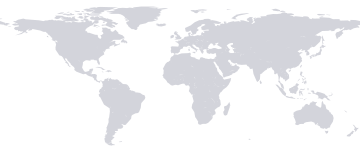
Gävle sits at 60.7°N, 17.1°E, 3 m above sea level, in Sweden. The nearest listed city is Sandviken, 21 km away.
Topography around Gävle
How much the land rises and falls, and what covers it, within 3, 16 and 80 km of Gävle.
Within 3 km, the terrain around Gävle has only modest variations in elevation — a maximum elevation change of 55 m around an average of 20 m above sea level; within 16 km, only modest variations in elevation — a maximum elevation change of 104 m; within 80 km, significant variations in elevation — a maximum elevation change of 499 m.
The land around Gävle is covered by trees (45%) and artificial surfaces (35%) within 3 km, trees (70%) within 16 km, and trees (63%) and water (26%) within 80 km.
Sweden travel facts
- Travel advisory
- Level 2
- Exercise Increased Caution
- Power plugs
- Type C / F
- 230 V · 50 Hz
- Prices
- ≈ 87% of US
- price level, 2025
- GDP per capita
- $63,133
- 2025
- Happiness
- 7.3 / 10
- World Happiness, 2025
- Safe drinking water
- 100%
- of population, 2024
- Homicide rate
- 1.1
- per 100k, 2023
- Road deaths
- 3.1
- per 100k/yr, 2019
- Income group
- High
- World Bank
- English
- Very high
- EF EPI 609
- Religion
Sources: World Bank, US State Department, World Happiness Report, WHO/UNICEF, EF EPI, CIA World Factbook.
Data sources
Temperature, precipitation, cloud, humidity, wind and solar figures are a 1991–2020 climatology for Gävle (60.6745°, 17.1417°, elevation 3 m), computed from hourly ERA5 reanalysis — contains modified Copernicus Climate Change Service information. Sun figures are astronomical calculations, not observations. City data © GeoNames, CC BY 4.0. Map outlines from Natural Earth (public domain); interactive map © Google. Sea temperatures are the NOAA OISST v2.1 1991–2020 monthly climatology (public domain), sampled at the nearest ocean point. UV index is derived from CAMS (Copernicus Atmosphere Monitoring Service) clear-sky UV data — contains modified Copernicus Atmosphere Monitoring Service information. Topography is sampled from the Copernicus DEM GLO-90 elevation model (© ESA/Airbus) and ESA WorldCover 2021 land cover (CC BY 4.0).