Sidi Bouzid in Spring
In spring (March, April and May), Sidi Bouzid sees average daytime highs around 24°C and overnight lows near 12°C, with 69 mm of rain over about 12 wet days across the season. It is the 3rd-warmest season and the 2nd-wettest season.
Over the season highs climb from about 19°C in early March to 30°C by late May. The sky is clear or mostly clear about 51% of the time across spring, and the air most often feels dry.
Spring is Sidi Bouzid's best season of the year to visit on our travel score. For the whole year in context, see Sidi Bouzid's year-round climate.
- Avg daytime high
- 24°C
- 3rd-warmest season
- Avg overnight low
- 12°C
- Rainfall
- 69 mm
- 12 wet days
- Avg wind
- 11 km/h
- Travel score
- 7.5
- best season of the year
- Months
- Mar · Apr · May
Temperature in Sidi Bouzid in Spring
Over the season highs climb from about 19°C in early March to 30°C by late May.
A typical spring day in Sidi Bouzid reaches about 24°C and drops to 12°C overnight. The warmest of the three months is May, the coolest March.
How spring really feels in Sidi Bouzid
Once humidity and wind are folded in, spring brings about 0 days that feel above 32°C and 0 that feel at or below 0°C.
spring sits comfortably in between — no days that feel dangerously hot or drop to a hard freeze once humidity and wind are folded in.
Sidi Bouzid weather by month
How the three spring months (March, April and May) compare with the rest of the year — the season's months are highlighted.
| Month | High / Low (°C) | Rainfall (mm) | Wet days | Daylight (hours) | Travel score |
|---|---|---|---|---|---|
| Jan | 16° / 6° | 21 | 3.1 | 9.9 | 5.9 |
| Feb | 17° / 6° | 18 | 3.9 | 10.7 | 6.5 |
| Mar | 20° / 9° | 29 | 4.6 | 11.7 | 7.4 |
| Apr | 24° / 12° | 24 | 4.2 | 12.9 | 8.0 |
| May | 28° / 16° | 16 | 3.2 | 13.8 | 7.1 |
| Jun | 33° / 20° | 8 | 2 | 14.3 | 4.2 |
| Jul | 37° / 23° | 4 | 1.3 | 14.1 | 2.3 |
| Aug | 36° / 23° | 12 | 3.1 | 13.3 | 2.6 |
| Sep | 31° / 20° | 33 | 5.3 | 12.2 | 5.1 |
| Oct | 26° / 16° | 28 | 4.6 | 11.1 | 7.7 |
| Nov | 21° / 11° | 24 | 3.3 | 10.2 | 7.8 |
| Dec | 17° / 7° | 16 | 3.2 | 9.7 | 6.6 |
Cloud cover in Spring
The sky is clear or mostly clear about 51% of the time across spring.
Chance of precipitation in Spring
Sidi Bouzid gets around 69 mm of rain over 12 wet days across spring. The line is the day-by-day chance of measurable precipitation.
Humidity in Spring
Most of spring feels dry — the stacked bands show each day's mix of comfort levels, read off the dew point.
Wind in Spring
Winds average 11 km/h across spring.
Sunrise & sunset in Spring
Daylight runs from about 11 h 12 min in early March to 14 h 12 min by late May. The lit band spans sunrise to sunset each day.
Solar energy in Spring
Average shortwave solar energy reaching the ground each day across spring, about 6.2 kWh/m².
Hazard calendar for Sidi Bouzid
In spring, Sidi Bouzid overlaps its dust season. The full year is below, with each hazard's peak months called out.
Sidi Bouzid sees seasonal dust haze (April–June), heaviest in June.
Is spring a good time to visit Sidi Bouzid?
Our two travel scores rate spring for general sightseeing and for beach or pool weather — 0 (poor) to 10 (ideal), averaged across the three months.
spring is one of the better times to visit Sidi Bouzid for general sightseeing. The water and warmth also suit a beach or pool day.
What to pack for Sidi Bouzid in Spring
From spring's temperature range, rain chance, sun and wind — what's worth putting in the bag.
In spring, Sidi Bouzid sees daytime highs around 24°C and nights near 12°C. Pack light clothes and sun protection. About 12 days see rain.
UV index in Sidi Bouzid in Spring
Clear-sky midday UV across spring averages around 6 — enough to warrant sun protection. The full-year curve, shaded by WHO exposure level, is below.
Under clear skies, the midday UV index in Sidi Bouzid peaks around July 13 at about 10 (very high) — sunscreen, a hat and midday shade are essential. It bottoms out near December 22 at about 2 (moderate).
The index reaches 3 or more — the level where the WHO recommends sun protection — in 10 months of the year.
| Jan | Feb | Mar | Apr | May | Jun | Jul | Aug | Sep | Oct | Nov | Dec | |
|---|---|---|---|---|---|---|---|---|---|---|---|---|
| UV index (midday) | 3 | 5 | 7 | 5 | 8 | 10 | 10 | 9 | 8 | 6 | 3 | 2 |
| Level | Moderate | Moderate | High | Moderate | Very high | Very high | Very high | Very high | Very high | High | Moderate | Moderate |
| UV index (midday) | Level | |
|---|---|---|
| Jan | 3 | Moderate |
| Feb | 5 | Moderate |
| Mar | 7 | High |
| Apr | 5 | Moderate |
| May | 8 | Very high |
| Jun | 10 | Very high |
| Jul | 10 | Very high |
| Aug | 9 | Very high |
| Sep | 8 | Very high |
| Oct | 6 | High |
| Nov | 3 | Moderate |
| Dec | 2 | Moderate |
Air quality in Sidi Bouzid in Spring
Average fine-particle pollution (PM2.5) through the year — so you can see where spring falls, not just the annual average.
Air quality in Sidi Bouzid is worst in March — around 26 µg/m³ PM2.5 (moderate), and holds fairly steady the rest of the year.
Modeled monthly averages (CAMS reanalysis, 2015–2024).
| Jan | Feb | Mar | Apr | May | Jun | Jul | Aug | Sep | Oct | Nov | Dec | |
|---|---|---|---|---|---|---|---|---|---|---|---|---|
| PM2.5 (µg/m³) | 24 | 24 | 26 | 25 | 22 | 21 | 18 | 19 | 22 | 25 | 25 | 23 |
| Level | Moderate | Moderate | Moderate | Moderate | Moderate | Moderate | Moderate | Moderate | Moderate | Moderate | Moderate | Moderate |
| PM2.5 (µg/m³) | Level | |
|---|---|---|
| Jan | 24 | Moderate |
| Feb | 24 | Moderate |
| Mar | 26 | Moderate |
| Apr | 25 | Moderate |
| May | 22 | Moderate |
| Jun | 21 | Moderate |
| Jul | 18 | Moderate |
| Aug | 19 | Moderate |
| Sep | 22 | Moderate |
| Oct | 25 | Moderate |
| Nov | 25 | Moderate |
| Dec | 23 | Moderate |
Where is Sidi Bouzid?
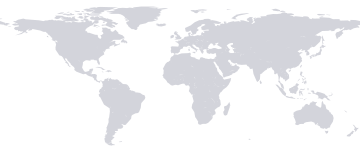
Sidi Bouzid sits at 35.0°N, 9.5°E, 332 m above sea level, in Tunisia. The nearest listed city is Sufetula, 39 km away.
Topography around Sidi Bouzid
How much the land rises and falls, and what covers it, within 3, 16 and 80 km of Sidi Bouzid.
Within 3 km, the terrain around Sidi Bouzid has only modest variations in elevation — a maximum elevation change of 39 m around an average of 334 m above sea level; within 16 km, significant variations in elevation — a maximum elevation change of 481 m; within 80 km, very significant variations in elevation — a maximum elevation change of 1,489 m.
The land around Sidi Bouzid is covered by artificial surfaces (31%) and cropland (30%) within 3 km, cropland (53%) and grassland (29%) within 16 km, and grassland (38%), cropland (34%) and bare terrain (23%) within 80 km.
Tunisia travel facts
- Travel advisory
- Level 2
- Exercise Increased Caution
- Power plugs
- Type C / E
- 230 V · 50 Hz
- Prices
- ≈ 29% of US
- price level, 2025
- GDP per capita
- $4,657
- 2025
- Happiness
- 4.8 / 10
- World Happiness, 2025
- Safe drinking water
- 65%
- of population, 2024
- Homicide rate
- 4.7
- per 100k, 2020
- Road deaths
- 16.5
- per 100k/yr, 2019
- Income group
- Lower middle
- World Bank
- English
- Low
- EF EPI 498
- Religion
Sources: World Bank, US State Department, World Happiness Report, WHO/UNICEF, EF EPI, CIA World Factbook.
Data sources
Temperature, precipitation, cloud, humidity, wind and solar figures are a 1991–2020 climatology for Sidi Bouzid (35.0382°, 9.4849°, elevation 332 m), computed from hourly ERA5 reanalysis — contains modified Copernicus Climate Change Service information. Sun figures are astronomical calculations, not observations. City data © GeoNames, CC BY 4.0. Map outlines from Natural Earth (public domain); interactive map © Google.